
We Are All Odysseus Now
On chaos, temptation, and the things that cannot be moved

“All strangeness holds danger now.”
Bernard Evslin, The Adventures of Ulysses
One night this week, I was on X at 1am, doing what I shouldn't have been doing. I watched one video about ten times, then let the algorithm serve me in quick succession: A woman shot in the face. AI predictions about infinite inequality. Prediction market bets on how quickly certain catastrophes might unfold.
When I finally put my phone down, I couldn’t sleep (surprise). My 10-month-old started stirring. I picked her up and kissed her forehead until her breathing steadied. As she lay asleep in my arms, innocent and impossibly soft, I reached for the one thing that reliably helps me drift into sleep: an audiobook. Some people take melatonin, but Stephen Fry usually does it for me.
I opened Audible and played his retelling of the Odyssey, a story I had already read in school but only dimly remembered.
I didn’t fall asleep until dawn. I hadn’t dropped off as usual, but stayed wide awake, my head bursting with images of a man as brave as he was fallible, who persevered in the face of unimaginable peril.
“Zeus might fill the sky with thunder booming clouds and scorch the world with cracks of lightning. But such displays were less than the whirling of gnats when compared to those terrible forces of time, fate, justice, necessity and retribution.
These powers had no face or figure. No personality, presence or place that could be prayed to or placated. But there came certain times when the signs of their workings could be most clearly felt.
This, now, Athena felt sure, was such a time.”
Stephen Fry, Odyssey
This may be the time we look back on many decades from now and realise it was then that the order holding our lives together finally came off its hinges. “But bad luck makes good stories” (Bernard Evslin, The Adventures of Ulysses), and so, as our world prepares for war and powerful technologies hold us in their grip, as we become desensitised to suffering and enraged at the idea of helping those in need, we are all setting out on the journey of Odysseus.
Odysseus is the king of a small Greek island called Ithaca. He is a man of great intelligence, cunning and charm. By coming up with the idea of the Trojan Horse, he was the key to winning the Trojan War.
But a journey home that should have taken him mere weeks turns into a 10-year-long ordeal. Everything repeatedly goes wrong for him. He suffers loss after loss, eventually losing every single one of his men.
Bound by the desire to return home, he finally succeeds, reuniting with his family.
The Odyssey is one of the oldest works of Western literature, composed around the 8th century BCE and attributed to the Greek poet Homer. Almost 3000 years later, it is seen as one of the most enduring narratives ever told.
Listening to it now, I was struck by how precisely it fits the present moment.
How do we live with constant peril?
How do we withstand temptation?
How do we persist through despair?
The Odyssey holds answers. Or maybe that's too strong - nothing really holds answers in this strange moment. But the journey offers sharp suggestions to prod our numbed instincts. While they are neither rosy nor easy, when the path towards a better place seems invisible, age old-adventures may be the best compass we have.
I Versatility: How to master constant peril?
Throughout his journey, Odysseus faces many perils, some otherworldly, caused by wrathful gods and monsters, and some entirely human, caused by his own pride and opportunism. The following disasters are examples of both.
The Cyclops
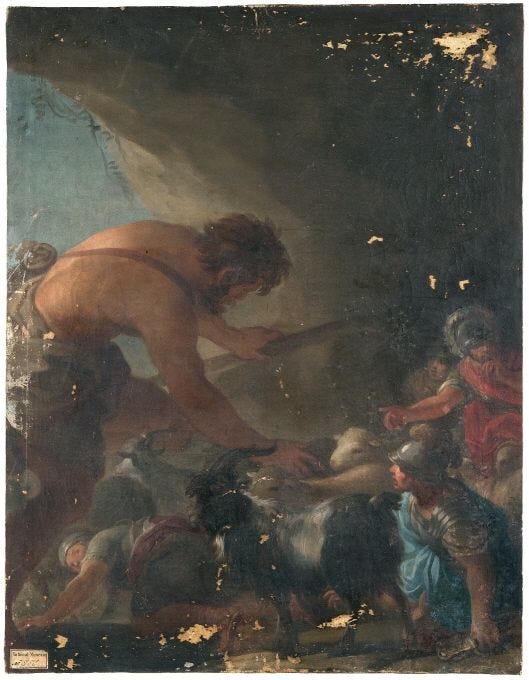
After days blown off course by storms, Odysseus and his men land on an island of the Cyclopes, a tribe of rogue giants, each living alone and herding sheep.
He leads twelve men into a cave filled with cheese and lambs. The host is Polyphemus, a one-eyed giant and son of Poseidon. He asks who they are. Odysseus reminds him that Zeus protects travellers and that harming guests is an offence to the gods.
Polyphemus laughs. He doesn’t fear Zeus. To prove it, he snatches up two of Odysseus’s men, smashes their heads against the floor, and eats them raw. Then he sleeps.
Odysseus considers killing him in the night. But he stops himself: only the Cyclops can move the boulder. If he dies, they’re entombed forever. So, instead, Odysseus waits.
The next evening, after Polyphemus eats two more men, Odysseus offers him strong, undiluted wine from his ships. The giant drinks deeply and asks his name. Odysseus answers: “My name is Nobody.”
When Polyphemus passes out drunk, Odysseus and his men drive a sharpened stake into his single eye. The giant screams. Other Cyclopes gather outside and ask what’s wrong. “Who is hurting you?” they call. Polyphemus shouts in agony: “Nobody! Nobody is hurting me!” So they leave, muttering that if nobody is hurting him, it must be a sickness from the gods.
In the morning, blind Polyphemus rolls back the boulder to let his sheep out to graze, feeling their backs to make sure no men escape. Odysseus has tied his men and himself underneath the sheep, clinging to the wool. They slip out, one by one, undetected.
They run for the ships and are safely rowing away when Odysseus can’t resist. He stands at the stern and shouts:
“Cyclops! If anyone asks who blinded you, tell them it was Odysseus, son of Laertes, lord of Ithaca!”
Polyphemus, who now knows who has hurt him, prays to his father Poseidon: Let Odysseus never reach home. Or if he must, let him arrive late, broken, alone, on a stranger’s ship, with all his companions dead, and find nothing but trouble in his house.
This is the source of Odysseus’s ensuing troubles. He had won. His men were escaping. All he had to do was stay silent. Ten years of suffering follow because he couldn’t, and every word of the curse comes true.
The encounter with the Cyclopes echoes a familiar human failing: the successes of brilliant minds are undone by their need for recognition.
I now think of this every time I watch powerful people who cannot resist gloating in public, baiting opponents, feeding feuds, and demanding the world’s attention like a child.
The only escape from our own hubris is to accept being nobody when it matters. This does not mean giving up one’s identity, but that any individual identity and need for validation should always follow the greater good.
Self-importance feels good in the moment, but paints a target on your back: there are always people waiting, thrilled, for your fall.
A life of twists and turns
Odysseus's journey continues amidst a sea of horrors: his fleet is destroyed by cannibalistic giants when his men moor together in a sheltered harbour that turns out to be a trap. He loses more crew to Scylla, a six-headed monster, because the alternative, the whirlpool Charybdis, would have surely taken them all. His remaining men slaughter the sacred cattle of the sun god Helios and are drowned for it, leaving Odysseus the sole survivor, clinging to a wreckage.
It is remarkable how similar the chaotic struggles of Odysseus’s world are to the global polycrisis we face today. The world was set against him, each escape leading only to the next trap. Rather than being isolated incidents, through the constant intermingling with the Gods, Odysseus’s struggles are a cascading and compounding disaster, like the wrath of the Cyclops incurring the wrath of Poseidon, who in turn causes every storm that follows.
Like our world today, this chaos offers no clean reset. Often, it therefore invokes a feeling of powerlessness, as the solution of one problem won’t solve the overall struggle, and overwhelm, as too many things interconnect at the same time.
It is Odysseus’s versatility that saves him from succumbing to the constant chaos of his world. The Greek word polytropos appears in the first line of Homer’s Odyssey, describing the many turns and ways of Odysseus. It is the recurring epithet throughout the books and captures both Odysseus’s wandering journey as well as his psychological flexibility: he keeps adapting.
More than ever, this current time demands immense flexibility from us. Neuroplasticity is the brain's ability to rewire itself. Polytropos is the soul's equivalent - a kind of anthroplasticity: the capacity to keep adapting when the world’s chaos keeps raging.
In the end, a key learning of Odysseus is that he cannot ever fully solve the cascading crisis, only outlast it. “He held the helm, grim and unsmiling”, sailing into each nightmare because there simply was no other direction.
II Resistance: How to withstand temptation?
Throughout their journey, Odysseus and his men are repeatedly tempted by the most powerful forces. How do they master saying no when the brutal journey only increases the need for a blissful escape?
The Lotus Eaters
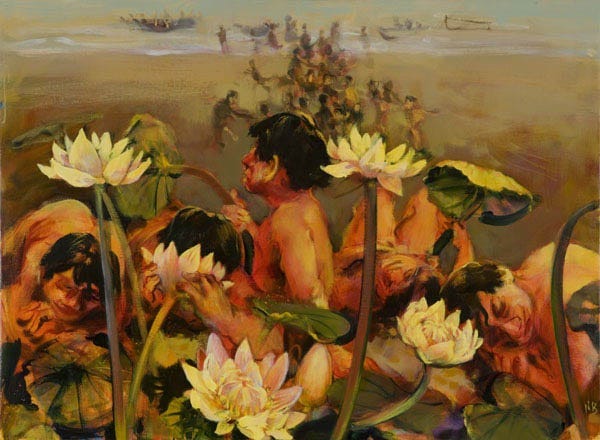
After leaving Troy, Odysseus’s fleet is blown off course by fierce storms. They land on an island inhabited by the Lotus Eaters who offer the men their food, the lotus flower. Those who eat it forget everything. There is no violence or pain that threatens them, they simply stop wanting to go home. They sit in a pleasant haze, perfectly happy, with no memory of wives, children, Ithaca, or the journey they were on.
Odysseus has to drag his men back to the ships by force, weeping and struggling. They do not want to be rescued because they have found something easier than their old lives: oblivion.
The Sirens
The Lotus Eaters offer oblivion. The Sirens offer something more dangerous: everything you ever wanted.
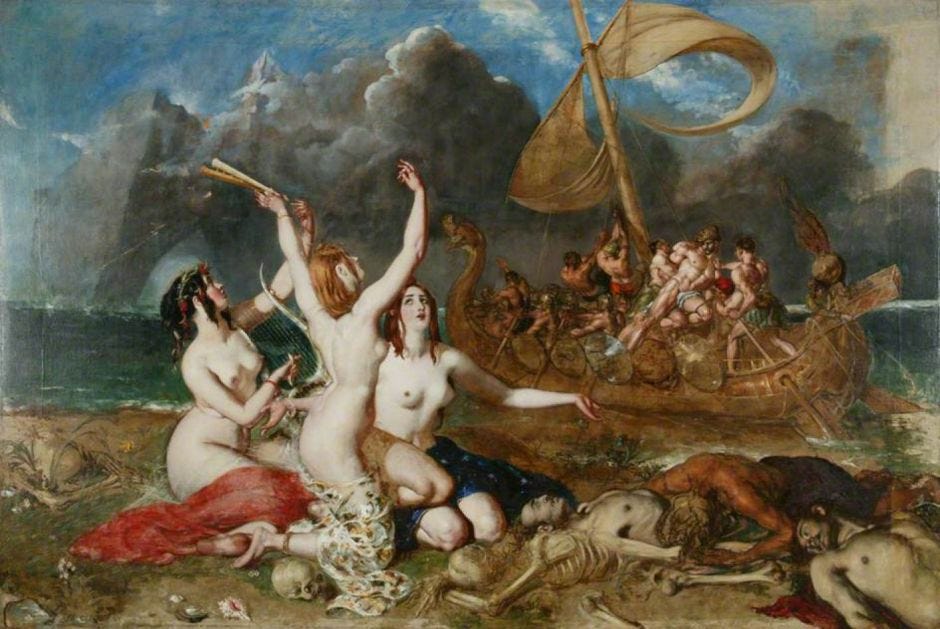
At another point later in his journey, Odysseus is warned by Goddess Circe that they will pass the island of the Sirens, creatures whose song is so beautiful that no sailor who hears it can resist. Every man who has ever heard them has steered towards their shore and met their end there, their bones piling up high on the rocks.
The Sirens promise knowledge. They sing of glory, of all you have done and all you could become, and of the secrets of the world laid bare. The song is perfectly calibrated to each listener. For Odysseus, they sing of Troy, of his own cunning, and of the wisdom they could share if only he would come near them.
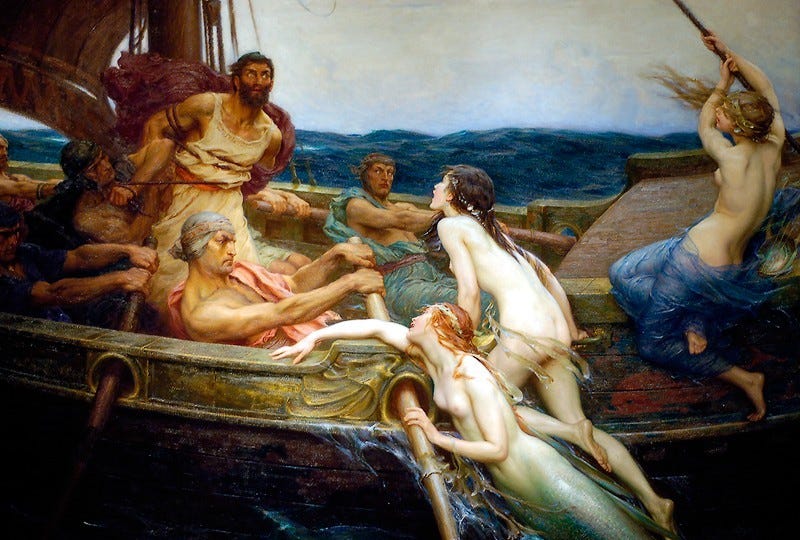
Circe gives precise instructions: the crew must plug their ears with beeswax so they hear nothing. But Odysseus, ever curious, wants to hear it himself. So he orders his men to tie him to the mast of the ship. He tells them: no matter what I say, no matter how I beg, do not untie me. And if I plead with you, only bind me tighter.
They sail. The crew is deaf with wax, but Odysseus hears everything. The song is more beautiful than anything he has ever known. He strains against the ropes. He screams at his men to release him. He promises, threatens and begs.
His men see his face twisted with longing and bind him tighter to the mast, exactly as he ordered.
They sail past the Sirens and the song fades. Odysseus survives not by resisting temptation in the moment, but by making surrender impossible before the moment arrives.
This is the original Ulysses pact, named after Odysseus (Ulysses in Latin): a binding restraint made in clarity, designed to hold when clarity fails. He knew his future self would be incapable of resistance, so his present self made the choice for him, leaving no room for reversal.
The Sirens are not defeated. They are still singing and their island is still covered in bones. Odysseus simply arranged in advance to not to succumb.
A Ulysses Pact for AI
The Sirens and the Lotus Eaters represent two faces of temptation: seduction and oblivion.
The Lotus Eaters are the pleasant haze of infinite scrolling: content that asks nothing of us, and slowly dissolves the memory of what we were trying to do with our lives.
The Sirens embody a different promise: mastery and insight without effort, something like omniscience on demand. But the bones on the shore suggest a cost we are not yet accounting for.
Has the time come for a Ulysses pact for AI? In a world of perfect temptation, our willpower is nothing but a joke. If there are parts of our humanity we want to protect, and if we know that AI’s pull will be strong enough to defeat our will, then a precommitment may be the only option.
I am not making the case for abstinence, but rather for rock solid boundaries: are there elements of our life so sacred, and temptations so well-perfected, that it is wise to refuse taking the risk of getting corrupted?
A Ulysses pact for AI might look like delegated override: the ability to switch off certain functions, where switching them back on requires not your consent, but someone else’s. A partner, a friend, or a family member.
The logic is simple: your future self cannot overrule your present self in a weak moment, and the people who love you will have your best interests at heart, even when you don’t. Most screen-time tools fail because the override is frictionless. In the face of powerful temptation, we need equally powerful restraint and nothing is more powerful than the people who care about us.
Odysseus didn't trust himself. That was the wisdom. He understood what he would become in the presence of the song and he made sure that version of himself could not act. The ropes did not prove that his will was weak, but that it was iron.
III Endurance: How to persist through despair?
At the end of Odysseus’s journey, one is left asking: how on earth does he persevere? How is he not defeated by permanent violent chaos, how does he not succumb to the easy temptations that promise abundance and oblivion?
The Greek saga offers us one more powerful concept: Odysseus’s deep sense of home. In Greek, nostos - homecoming - describes a hero returning home after having been tested by many trials. Throughout his journey, despite the various temptations, Odysseus never loses sight of his birthplace, Ithaca, and his family there.
When the goddess Calypso offers Odysseus immortality - eternal life, eternal youth, and herself as a lover - he refuses. “I know that [my wife] Penelope cannot match you for beauty,” he tells her. “She is mortal, and you are immortal and ageless. But even so, I want to go home. I long for the day of my return.”
On her island, blessed with every comfort, he sits on the rocks each day and weeps, gazing out over the sea. He does so for seven years.
There is no complex learning or cunning insight here. Just the simple fact that endurance requires something to endure for.
In the Odyssey, these things are as concrete as they are ordinary: a home, a wife, a son, a bed built into a living olive tree that cannot be moved. Rather than abstract visions of grandeur, Odysseus's perseverance is driven by these specific attachments that bind him to his old life - and therefore, eventually, enable him to return.
This is the question the Odyssey leaves with us. Not how to be clever, how to be brave, or how to resist temptation, but whether we have something worth enduring for.
What makes this world, today, a place we would fight for until our last breath? What would we weep for bitterly, as Odysseus wept, if it were taken from us? What, in the face of utmost temptation, convinces us to stay the course and amid unending peril, allows us to say: "I can bear that too, with a spirit tempered to endure"?
The Odyssey is not a promise that we will make it home. Odysseus did, but only just barely, and at an unthinkable cost. The journey of twists and turns is an observation that man is fallible and that brutal chaos is unavoidable: “forces that cannot be prayed to or placated”.
Yet, it also conveys that things move ever forward, and so can we, if we keep our eyes set on the simple but powerful things that cannot be moved.
For me, that night of mythical adventures did not end in a wild theory about AI. It ended with the weight of my sleeping daughter in my arms, her breathing steady against my skin.
She is my Ithaca. That is what cannot be moved.
We are all Odysseus now.
Beautifully written. I have noticed many people turning to the classics recently. I had more conversations about the Epic of Gilgamesh in the past month than in my entire life up to this point.
I think we can sense that relativism will not sustain us through whatever is to come. We feel the need for an older moral language, one where courage, loyalty, endurance still carry weight. At the same time, we are suspicious of hero narratives. They put impossible pressure on people, are structurally fragile, and usually end badly. Odysseus resonates because he offers a third way between relativism and hero worship. He is human, not transcendent, not morally pure. His task is not to seek glory but to say, I am fallible, I am tempted by the wrong things, but still I will take responsibility for what is mine to hold. It's unglamorous in many ways, but it feels truer than much of our current public discourse.
Well done Judith!
As a combat veteran myself, the Odyssey has a special place in my heart. It has helped me immensely - to see the cognitive traps that keep one from finding one's way "home" - and also to overcome them. It has now been 20 years since my last deployment, after which I began my own long and arduous journey to find myself - and I am finally making an effort to emphasize - in writing - the invaluable principles I learned from the Odyssey.
Would love your feedback!
Intro: https://andrewsawyer.substack.com/p/coming-soon-the-way-home-a-nine-part
Part 1: https://andrewsawyer.substack.com/p/the-way-home-part-1-calypsos-island
Part 2: https://andrewsawyer.substack.com/p/the-way-home-part-2-the-phaeacians
Part 3 is scheduled to publish on 01/17/26, and I hope to keep the pace of one essay per week until I've worked through all nine of the spiritual lessons. Blessings to you and yours!